The growing global demand for agricultural products is generating investment opportunities in land, particularly in Africa where large tracts of land are made easily available by weak government institutions. Without a strong voice or political power, the needs and demands of rural communities who live and rely on this land are often disregarded. There is an effort being made by communities, associations, NGOs and other aspects of civil society to push back and protect the rights of the rural poor.
Using issues of land and land rights in Mozambique as a case study, this research explores how civil society is formed in relation to community needs, government (in)action and investor pressures. Community and investor relations with the land and each other are discussed to better understand the conflict that is being created as a result of increased pressure on land. Within the Mozambican context, conflict between these two stakeholders is generally compounded by the government which practices both bottom up community development and top down promotion of large scale land deals which often ignore the rights of communities. Low levels of education and poor democratic representation has left the rural poor with minimal capacity to independently work towards securing their rights to land, but they are not without resources. Mozambique has one of the most progressive land laws in Africa in regards to protecting the rights of peasants; yet it is not able to prevent the abuse of rural populations which is rampant across Africa. However, there is a growing capacity within civil society, which still is relatively weak compared to the government, to challenge the marginal enforcement of the law.
In researching this conflict during his two-month stay in Mozambique, civil society’s role in community empowerment and capacity building began to emerge to the author as an important tool of protecting peasant rights and promoting rural development. Associations and national non-governmental organisations which form the core of civil society serve to promote community-based development with the aim of making them visible to government and integrating rural Mozambicans into the larger Mozambican society. Ultimately these activities contribute towards enhancing civil society in Mozambique which the author trys to locate between de Tocquevillian and Gramscian conceptions of civil society.
This is a thesis submitted in part of the MA in International Development at the University of Sheffield.
Author: Nicholas Hess Follow @nicholashess_
 Community Need, Government (in)action and External Pressure: A Study of Civil Society and Land Rights in Mozambique (2394)

Latest Updates
Community Need, Government (in)action and External Pressure: A Study of Civil Society and Land Rights in Mozambique
From Aid Effectiveness to Development Effectiveness: Paying Tribute to the WP-EFF
The Paris Declaration on Aid Effectiveness in 2005 was a watershed for the Development co-operation community and has since then been endorsed by more than 150 countries and major international organizations. Behind the Paris forum, and its successors the Accra and Busan forums (2008 and 2011), was the well known “Working Party on Aid Effectiveness”, or WP-EFF, an original global but informal multi-stakeholder partnership hosted by the OECD-DAC. In June 2012, as the WP-EFF is closing to leave the way to the new Global Partnership for Effective Development Cooperation, the OECD’s Hubert De Milly examines the origin and achievements of the WP-EFF, to better understand the pillars on which the new Partnership is built.
Article by Hubert De Milly
From Aid Effectiveness to Development Effectiveness: Paying Tribute to the WP-EFF (2022)
Under what circumstances are NGOs unable to gain access to vulnerable populations? What are the implications for aid policy?
Gaining access to vulnerable populations is frequently difficult. Non-Governmental Organisations (NGOs) face many circumstances where they are unable to gain access to vulnerable populations, as well as fierce criticism when they fail in their relief efforts. As with much of aid and development, the story isn’t wholly negative and there have been significant technical innovations recently that have facilitated improved access for NGOs. NGOs continue to operate in remote, unpopular and hostile environments and the challenges they face should not be overlooked. This paper’s aim is not to criticise what is already widely regarded as a flawed sector within the aid industry; rather it is to constructively contribute to the debate on access.
It distinguishes two main thematic areas under which NGOs are unable to gain access to vulnerable populations, namely: technicalities and hostile conflict zones. It also explores the idea that these circumstances mask deeper factors in providing relief; strategic interest and convenience. These influences are indicative of a shift in aid policy which is discussed in an analysis on the implications of ‘access’ on aid policy in terms of conceptual, political and practical implications.
Author: Hannah Taylor
Under what circumstances are NGOs unable to gain access to vulnerable populations? What are the implications for aid policy? (2008)
Inter-Organisational Cooperation of Haitian NGOs in Education – A Haitian Perspective
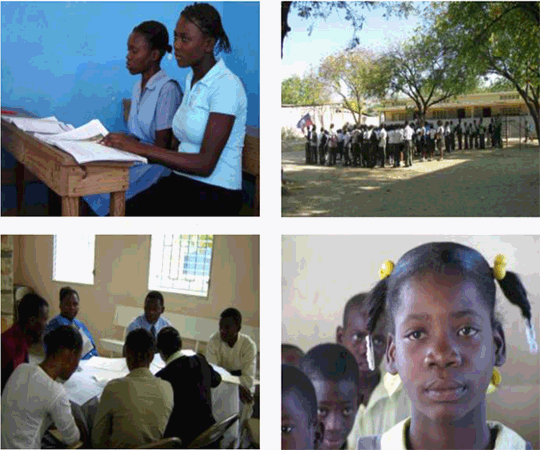 In Haiti, around 90% of the schools are operated by non-public providers. Many NGOs are active in the domain of education. Coordination and cooperation is a big challenge, especially in the transition phase from humanitarian relief to development, one year after the devastating earthquake in January 2010.
In this project report submitted in part of an MSc in Development Management the author – after an exploration of the problem from a theoretical perspective – the outcomes of semi-structured interviews with NGO directors and education coordinators in Haiti provides an insight into six different inter-organisational cooperation trajectories with NGOs.
The reasons why organisations enter and participate in inter-organisational cooperation trajectories include objectives in the following domains: improved coordination, increased effectiveness, more technical capacity and shared curriculum development, shared policy development, stronger advocacy and increased chances for fundraising.
However this report highlights the fact that the most important condition for inter-organisational cooperation is the development of a shared vision.
Report Author: Marike de Kloe
Inter-Organisational Cooperation of Haitian NGOs in Education – A Haitian Perspective (3598)
Featured Projects
The Learn Africa Project: Public Health, Applied Learning and Research Internship
Trevor Mattos is a Pike Scholar at Gordon College, Massachusetts. Earlier this year he and a colleague Miranda MacKinnon travelled to Togo, West Africa to direct a Development and Public Health project that had been planned since the previous year.
This project report details the establishment of the ‘The Learn Africa Project’ and highlights some of the challenges and planning required in establishing a community development and public health project from the base up in a Developing Country. It also highlights the principle research undertaken in preparation for the estabishment of the project.
Report Author: Trevor Mattos
Demographic Dimensions and their Implications on the Incidence of Street Begging in Urban Areas of Central Tanzania: The Case of Dodoma and Singida Municipalities
This study explores the implications of demographic dimensions on the incidence of street begging in urban areas of central Tanzania with Dodoma and Singida Municipalities as case studies. This study was conducted on different days at different streets and public spaces in Dodoma and Singida Municipalities to obtain data on incidence of street begging. A cross-sectional survey was employed and involved 130 street beggars. Structured questionnaires were administered on randomly selected beggars to obtain data on their demographic dimensions. Group discussions, key informant interview, and observations were also used to collect data relevant for the study.
Authors:Baltazar M.L. Namwata, Maseke R. Mgabo and Provident Dimoso
Demographic Dimensions and their Implications on the Incidence of Street Begging in Urban Areas of Central Tanzania (7160)
Dadaab Refugee Camps, Kenya
With conflict and continuing uncertainty affecting the future of Somalia following the US backed Ethiopian invasion it is little wonder Somalis continue to flee their disintegrating country. Since the early 1990’s when large scale civil war broke out the Somali Diaspora has spread far and wide. Nearly a million have fled to already poor neighbouring countries and 400,000 of those headed south to Kenya. Though many have managed to return since there remains over 100,000 mostly Somali refugees in Northern and Eastern Kenya.
Featured Articles & Papers
From Abandonment to Inclusion: The Role of the State in Violence, Public Security and Human Rights in favela communities in Rio de Janeiro – The Case Studies of Santa Marta and City of God
Beginning in December of 2008, the State of Rio de Janeiro and federal government of Brazil began a new policy shift in securitizing favela communities. In an effort to combat the city’s drug traffickers and prevalent violence, the State began installing “pacification” or “peacekeeping” units in vulnerable favela communities. Following pacification, the State then increases investment in infrastructure and social programs.
Drawn from the authors’ experience of living in Rio, this award nominated paper looks at the evolving role of the State of Rio de Janeiro in recent years in two specific favela communities: Santa Marta and City of God. As the city prepares to host the 2014 World Cup and 2016 Olympic Games, preparations mount and the international community awaits to see what Rio is capable of accomplishing in their fight to eliminate the city’s famous drug trade and infamous violence. Will these preparations benefit those most marginalized? Or will it continue to push the socially excluded even further into the periphery?
After multiple failed security policies since the 1980s, recent actions and investments show the State’s new human rights based approach to security and social and economic investment. Fulfilling its national and international obligations of respecting, protecting and fulfilling the rights of all citizens while also moving forward on a path of progressive economic and social development, the State of Rio de Janeiro is entering a new era. Its new policies are battling a deeper embedded structural violence while enhancing the capabilities of formerly deprived citizens. Santa Marta and City of God serve as case studies in analyzing the State of Rio de Janeiro, its fulfillment of human rights obligations and its progressive path of economic and social development in favela communities.
Author Mary E. Robbins
From Abandonment to Inclusion: The Role of the State in Violence, Public Security and Human Rights in favela communities in Rio de Janeiro, The Case Studies of Santa Marta and City of God (5085)
Hii Dunia – New Editor Wanted
Dear Readers,
Although almost dormant for the last few months, Hii Dunia has for nearly nine years being regularly posting articles, papers and blog posts on Global Development and Environmental subjects. It’s goal was to aid and expand the discourse in these areas by publishing online pieces of work that may otherwise have only been read by a tutor and the author themselves.
From first appearing as a blog in 2006 posting short-form articles, re-edited chapters from submitted academic papers and even a photograph of the day (!?) it slowly expanded to become www.hiidunia.com and published full academic papers in either abridged or in full form as well as a link to a PDF of the original paper.
Hii Dunia was nominated for an award early on and has also received lots of praise particularly for the addition of it’s extensive Development Directory page – which is still one of the largest freely available online Directories of its type.
Promoting the contributors to the site has been key and the community that has built up as a result has been one of the unforeseen delights of Hii Dunia. The site has gained 2000 Twitter followers and still attracts high traffic. Some papers we’ve posted have gained many thousands of views and have been cited elsewhere including in PhD Theses.
It is with some sadness therefore that I am advertising here for a new Editor to take over the reigns at Hii Dunia. My career has shifted in the last few months and whilst I’m very happy with where it’s headed I have now found it impossible to give the site the attention it requires. Therefore I’m looking for someone to take over – ideally with a passion for Global Development, who wants to make contacts within the sector and who believes that as much Global Development material as possible should be fully in the public domain.
Perhaps you are a student looking to enhance your CV and wanting to learn more form the papers you’ll publish? Perhaps you’re new to the sector and want to form links with practitioners, academics and students within it too?
The possibilities are endless. I think I’ve only begun to explore what can be done with a platform like this. You would have ‘the keys’ to Hii Dunia, all the assets such as logos etc and make the changes you see fit. Maybe you would want to orientate it more towards project work – collecting experiences of Development practitioners in the field? Expand it’s presence on Social Media? Completely change the look and layout? As editor it would be up to you.
The main tasks as Editor include making contact with potential contributors, requesting papers and other content that you both feel is suitable for the site. Keeping all the other aspects of the site up to date – checking for broken links in the Directory for example, contacting contributors to update their profiles and posting regular Social Media updates. You will need to have a working knowledge of Wordpress alongside photo editing software such as Photoshop.
If this sounds like something that might be of interest to you email me at editor@hiidunia.com giving a little bit of background about yourself, what you do, why you want to take on Hii Dunia and the direction you might take it. If you have the passion and dedication to run a site like this I’ll be happy to hand it over.
Editing Hii Dunia has been a extremely rewarding experience, its put me in touch with some fantastic people within the Development sphere and further afield and broadened my own as well as I hope it’s readers understanding of an increasingly vital subject. I hope the next nine years will be as rewarding as the first.
Daniel Corns
Editor
Large Scale Biofuel Projects in Mozambique: A Solution to Poverty?
There has recently been a large increase in global land acquisitions for fuel and food production. This has been spurred on by the combined global food, fuel and financial crisis. Speculators have been seeking out ‘cheap’ and what the investors and international development agencies term ‘idle land’ to occupy or lease. Large tracts of land are being allocated predominantly from developing nations such as Sub-Saharan Africa, Asia, Latin America and Eastern Europe – and in the majority of cases the land is not ‘idle’ at all.
The large scale biofuel industry plays a significant role in this and has expanded rapidly in recent years, particularly in Mozambique. In this thesis the author aims to examine whether developing nations such as Mozambique have achieved poverty reduction through large scale biofuel projects and the assesses the impact it has made on many ordinary landowners in that country.
Author: Claire Burgess Follow @Claireburgo
Large Scale Biofuel Projects in Mozambique: A Solution to Poverty? (13247)